[[Image:VaginaDentata-GoddessCafe.jpg|thumbnail|right|200px|Image taken from Goddess Cafe]]
Latin for "toothed vagina".
Often crops up as a sexist projection onto women's bodies of men's fear of women's sexuality. Devouring mothers and all that.
[[category:Fictional inventions]]
Sometimes appears in fiction as an instance of fantastical biology, or a science-fictional body modification or device.
==Mythology and psychology==
A common motif in certain cultural legends and myths. For instance, the Navajo's story of "Snapping Vagina" included a vagina dentata that produced lightning. Apache and Navajo stories featured women who killed men with their toothed vaginas; the heroes could destroy them by destroying their teeth.<ref>See Carolyne Larrington, ed., ''The Feminist Companion to Mythology'' 1992, ISBN 0-04-440850-1.</ref>
In ''[[The Woman's Encyclopedia of Myths and Secrets]]'', [[Barbara Walker]] defines the vagina dentata as:
: [T]he classic symbol of men's fear of sex, expressing the unconscious belief that a woman may eat or castrate her partner during intercourse. Freud said, "Probably no male human being is spared the terrifying shock of threatened castration at the sight of female genitals." But he had the reason wrong. The real reason for this "terrifying shock" is a mouth-symbolism, now recognized universally in myth and fantasy: "It is well-known in psychiatry that both males and females fantasize as a mouth the female's entranceway to the vagina."
: The more patriarchal the society, the more fear seems to be aroused by the fantasy. ...
: Stories of the devouring Mother are ubiquitous in myths, representing the death-fear which the male psyche often transformed into a sex-fear. Ancient writings describe the male sexual function not as "taking" or "posessing" the female, but rather "being taken" or "putting forth." Ejaculation was viewed as a loss of a man's vital force, which was "eaten" by a woman. ...
: Distinction between mouths and female genitals was blurred by the Greek idea of the laminae -- lustful she-demons, born of the Libyan snake-goddess Lamia. Their name meant either "lecherous vaginas" or "gluttonous gullets." [[Lamia]] was a Greek name for the divine female serpent called Kundalini in India, Uraeus or Per-Uatchet in Egypt, and Lamashtu in Babylon. Her Babylonian consort was Pazuzu, he of the serpent penis. Lamia's legend, with its notion that males are born to be eaten, led to Pliny's report on the sexual lives of snakes which was widely believed throughout Europe even up to the 20th century: a male snake fertilizes the female snake by putting his head into her mouth and allowing himself to be eaten.
: Sioux Indians told a tale similar to that of the Lamia. A beautiful seductive woman accepted the love of a young warrior and united with him inside a cloud. When the cloud lifted, the woman stood alone. The man was a heap of bones being gnawed by snakes at her feet.
: Mouth and vulva were equated in many Egyptian myths. ...
: "Mouth" comes from the same root as "mother" -- Anglo-Saxon ''muth'', also related to the Egyptian Goddess Mut. Vulvas have ''labiae'', "lips," and many men have believed that behind the lips lie teeth. Christian authorities of the Middle Ages taught that certain witches, with the help of the moon and magic spells, could grow fangs in their vaginas. They likened women's genitals to the "yawning" mouth of hell, though this was hardly original; the underworld gate had always been the yoni of Mother Hel. It has always "yawned" -- from Middle English ''yonen'', another derivatave of "yoni." A German vulgarity meaning "cunt," ''Fotze'' in parts of Bavaria meant simply "mouth."
: To Christian ascetics, Hell-mouth and the vagina drew upon the same ancient symbolism. Both were equated with the womb-symbol of the whale that swallowed Jonah; according to this "prophecy" the Hell-mouth swallowed Christ (as Hina swallowed her son Maui) and kept him for three days. Visionary trips to hell often read like "a description of the experience of being born, but in reverse, as if the child was being drawn into the womb and destroyed there, instead of being formed and given life." St. Teresa of Avila said her vision of a visit to hell was "an oppression, a suffocation, and an affliction so agonizing, and accompanied by such a hopeless and distressing misery that no words I could find would adequately describe it. To say that it was as if my soul were being continuously torn fro my body is as nothing."
: The archetypal image of "devouring" female genitals seems undeniably alive even in the modern world. "Males in our culture are so afraid of direct contact with female genitalia, and are even afraid of referring to these genitalia themselves; they largely displace their feelings to the accessory sex organs -- the hips, legs, breasts, buttocks, etc. -- and they give these accessory sex organs an exaggerated interest and desirability." Even here, the male scholar inexplicably "displaces" the words sex organ onto structures that have nothing to do with sexual functioning.
: Looking into, touching, entering the female orifice seems fraught with hidden fears, signified by the confusion of sex with death in overwhelming numbers of male minds and myths. Psychiatrists says sex is perceived by the male unconscious as dying: "Every orgasm is a little death: the death of the 'little man,' the penis." Here indeed is the root of ascetic religions that equated the denial of death with the denial of sex.
: Moslems attributed all kinds of dread powers to a vulva. It could "bite off" a man's eye-beam, resulting in blindness for any man who looked into its cavity. A sultan of Damascus was said to have lost his sight in this manner. Christian legend claimed he went to Sardinia to be cured of his blindness by a miraculous idol of the Virgin Mary -- who, being eternally virgin, had her door-mouth permanently closed by a veil-hymen.
: Apparently Freud was wrong in assuming that men's fear of female genitals was based on the idea that the female had been castrated. The fear was much less empathetic, and more personal: a fear of being devoured, of experiencing the birth trauma in reverse. A Catholic scholar's curious description of the Hell-mouh as a womb inadvertently reveals this idea: "When we think of man entering hell we think of him as establishing contact with the most intrinsic, unified, ultimate and deepest level of the reality of the world."
==As technological rape deterrent==
[[Image:SonetteEhlers-RapexFemaleCondom.jpg|thumbnail|right|200px|Sonette Ehlers with a screenshot and a prototype of the Rapex, a female condom. (Photo: Reuters, taken from Robyn Dixon, "[http://www.smh.com.au/news/world/controversy-in-south-africa-over-device-to-snare-rapists/2005/09/01/1125302683893.html?oneclick=true Controversy in South Africa over device to snare rapists]", Sept. 2, 2005.)]]
The development of a real-life version (the "Rapex", invented by Sonette Ehlers in 2005) inspired various criticisms:
# that they would be useless against rape committed with the help of foreign objects;
# the use might enrage rapists and incite further violence;
# they offered revenge not deterrence;
# they might expose victims to blood-borne contagions should their attackers' skin break;
# as a [[rape]] deterrent, the concept rather rests on the presumption that men will have access to women's bodies anyhow, and that they will go far enough for a device located in the vagina to make any difference, thereby circumscribing women's inevitable position as victims.
Ehlers said she had been inspired to invent it after meeting a woman who had been raped who told her, "If only I had teeth down there."<ref>Dixon, Robyn (September 2 2005). "Controversy in South Africa over device to snare rapists".</ref>
===Fictional depictions===
* Neal Stephenson's ''[[Snow Crash]]'' (thirteen-year-old [[Y.T.]] uses a rape defense "vagina dentata" which, unless disabled, injects a rapid-acting sedative on penetration, allowing someone to get away)
==Vagina dentata imagery and analysis==
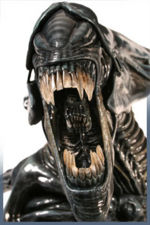
* [[Image:SideshowCollectibles-14Scale-AliensQueen.jpg|150px|right|thumbnail|Image of a Sideshow Collectible version of the Alien Queen from "[[Aliens]]"; image taken from [http://www.sideshowtoy.com/cgi-bin/category.cgi?category=082004alien review by Willie Goldman] at SideShowToy.com]] "[[Alien]]" and H.R. Giger's imagery generally:
: The alien's mouths have long been the quintessential vagina dentata -- complete with a bonus phallus dentata that shoots out at will -- so Jeunet ups the ante by having Ripley tear the penile tongue out of a dead monster and offer it to Ryder as "a nice souvenir."<ref>Laura Miller, [http://www.salon.com/ent/movies/1997/11/26alien.html Return of the vagina dentata from outer space!], Salonc.om, Nov. 26, 1997 (review of "Alien Resurrection").</ref>
* Piero Schivazappa's "Femina Ridens" (transl. "Frightened Woman", 1969; a non-SF work); misogynystic millionaire kidnaps and tortures a woman; he creates a vagina dentata doorway.
* "Independence Day"'s alien ships: [[Image:IndependenceDay-Cover.gif|thumb|right|100px|Cover of "Independence Day" DVD]]
: Independence Day reinforces the notion that femininity is a threat to American society in its depiction of the actual alien invasion. When the alien spaceships go into attack mode, they present the viewer with the image of a vagina dentata, an age-old cultural icon which locates destruction (teeth) within the site of heterosexual masculine pleasure (the vagina). This is the sort of image Barbara Creed talks about in her book The Monstrous-Feminine, which analyzes threats to masculinity in the context of science-fiction and horror cinema. Independence Day's alien ships align themselves perfectly with her conceptualizations of the destructive feminine threat to male ideology. After parking itself conspicuously and directly over the point of the Capitol Building in Los Angeles, one of theseships opens at the underbelly to reveal, between its jagged metal teeth, a weapon extending down from it which releases its destructive rays, incinerating the skyscrapers on impact. According to Creed, the horror of science fiction's alien exterminators has, at its base, the idea that "phallocentric ideology" is "terrified at the thought that women might desire the phallus." The weapon on the alien ships is depicted as a feminine phallus. It is not Planet Earth that is under attack, but the male perogative. The aliens' attack is merely the culmination of a war that was underway long before their arrival, a war on the masculinity of the film's protagonists. President Whitmore's enervating reliance upon and care for women, Stevie Hiller's affiliation with degenerate female sexuality, Russell's emasculation at the hands of the castrating aliens/Vietnam War, and David's subjugation to the career and domestic demands of his powerful wife have all placed them, on July 2, at the feet of this awesome and unavoidable feminine power.<ref>Scott Thill, "[http://bad.eserver.org/issues/1997/31/thill.html Independence Day and the Renationalization of America]," ''Bad Subjects'', Issue #31, March 1997.</ref>
== Examples ==
* [[Tanith Lee]]'s "Weasel Bride" (fantasy)
== Further reading ==
* Pat Carr, "The Vagina Dentata Motif in Nahuatl and Pueblo Mythic Narratives: A Comparative Study," ''New Scholar: An Americanist Review'' (1982), v. 8, nos. 1-2, pp. 85-101.
* Leonard Cassuto. "Repulsive Attractions: 'The Raft,' the Vagina Dentata, and the Slasher Formula." in Kathleen Margaret Lant & Theresa Thompson, eds., ''Imagining the Worst: Stephen King and the Representation of Women.'' (Westport, CT: Greenwood, 1998), pp. 61-78.
* Grosz, Elizabeth. "Animal Sex: Libido as Desire and Death," Sexy bodies: the strange carnalities of feminism (New York: Routledge, 1995), pp. 278-299.
* Horney, Karen. "The Dread of Women," International Journal of Psycho-Analysis, 13 (1932), 348-60.
* Ruth Markus, "Surrealism's Praying Mantis and Castrating Woman," ''Woman's Art Journal'', Spring-Summer 2000, v.21, n.1, pp. 33-39. (vagina dentata and related imagery in surrealist painting)
* Otero, Solimar. "'Fearing Our Mothers': An Overview of the Psychoanalytic Theories Concerning the Vagina Dentata Motif", ''American Journal of Psychoanalysis'', Sept. 1996, v. 56 n. 3, pp. 269-288.
* Raitt, Jill. Article on "vagina dentata," Journal of the American Academy of Religion, 48 (1980), 415-431.
* [[Barbara Walker]]. [[The Woman's Encyclopedia of Myths and Secrets]]
* [http://goddesscafe.com/yoni/dentata.html Vagina Dentata] at The Goddess Café, Yoni Temple
* [http://en.wikipedia.org/wiki/Vagina_dentata Wikipedia entry about vagina dentata]
A common motif in certain cultural legends and myths. For instance, the Navajo's story of "Snapping Vagina" included a vagina dentata that produced lightning. Apache and Navajo stories featured women who killed men with their toothed vaginas; the heroes could destroy them by destroying their teeth.[1]
[T]he classic symbol of men's fear of sex, expressing the unconscious belief that a woman may eat or castrate her partner during intercourse. Freud said, "Probably no male human being is spared the terrifying shock of threatened castration at the sight of female genitals." But he had the reason wrong. The real reason for this "terrifying shock" is a mouth-symbolism, now recognized universally in myth and fantasy: "It is well-known in psychiatry that both males and females fantasize as a mouth the female's entranceway to the vagina."
The more patriarchal the society, the more fear seems to be aroused by the fantasy. ...
Stories of the devouring Mother are ubiquitous in myths, representing the death-fear which the male psyche often transformed into a sex-fear. Ancient writings describe the male sexual function not as "taking" or "posessing" the female, but rather "being taken" or "putting forth." Ejaculation was viewed as a loss of a man's vital force, which was "eaten" by a woman. ...
Distinction between mouths and female genitals was blurred by the Greek idea of the laminae -- lustful she-demons, born of the Libyan snake-goddess Lamia. Their name meant either "lecherous vaginas" or "gluttonous gullets." Lamia was a Greek name for the divine female serpent called Kundalini in India, Uraeus or Per-Uatchet in Egypt, and Lamashtu in Babylon. Her Babylonian consort was Pazuzu, he of the serpent penis. Lamia's legend, with its notion that males are born to be eaten, led to Pliny's report on the sexual lives of snakes which was widely believed throughout Europe even up to the 20th century: a male snake fertilizes the female snake by putting his head into her mouth and allowing himself to be eaten.
Sioux Indians told a tale similar to that of the Lamia. A beautiful seductive woman accepted the love of a young warrior and united with him inside a cloud. When the cloud lifted, the woman stood alone. The man was a heap of bones being gnawed by snakes at her feet.
Mouth and vulva were equated in many Egyptian myths. ...
"Mouth" comes from the same root as "mother" -- Anglo-Saxon muth, also related to the Egyptian Goddess Mut. Vulvas have labiae, "lips," and many men have believed that behind the lips lie teeth. Christian authorities of the Middle Ages taught that certain witches, with the help of the moon and magic spells, could grow fangs in their vaginas. They likened women's genitals to the "yawning" mouth of hell, though this was hardly original; the underworld gate had always been the yoni of Mother Hel. It has always "yawned" -- from Middle English yonen, another derivatave of "yoni." A German vulgarity meaning "cunt," Fotze in parts of Bavaria meant simply "mouth."
To Christian ascetics, Hell-mouth and the vagina drew upon the same ancient symbolism. Both were equated with the womb-symbol of the whale that swallowed Jonah; according to this "prophecy" the Hell-mouth swallowed Christ (as Hina swallowed her son Maui) and kept him for three days. Visionary trips to hell often read like "a description of the experience of being born, but in reverse, as if the child was being drawn into the womb and destroyed there, instead of being formed and given life." St. Teresa of Avila said her vision of a visit to hell was "an oppression, a suffocation, and an affliction so agonizing, and accompanied by such a hopeless and distressing misery that no words I could find would adequately describe it. To say that it was as if my soul were being continuously torn fro my body is as nothing."
The archetypal image of "devouring" female genitals seems undeniably alive even in the modern world. "Males in our culture are so afraid of direct contact with female genitalia, and are even afraid of referring to these genitalia themselves; they largely displace their feelings to the accessory sex organs -- the hips, legs, breasts, buttocks, etc. -- and they give these accessory sex organs an exaggerated interest and desirability." Even here, the male scholar inexplicably "displaces" the words sex organ onto structures that have nothing to do with sexual functioning.
Looking into, touching, entering the female orifice seems fraught with hidden fears, signified by the confusion of sex with death in overwhelming numbers of male minds and myths. Psychiatrists says sex is perceived by the male unconscious as dying: "Every orgasm is a little death: the death of the 'little man,' the penis." Here indeed is the root of ascetic religions that equated the denial of death with the denial of sex.
Moslems attributed all kinds of dread powers to a vulva. It could "bite off" a man's eye-beam, resulting in blindness for any man who looked into its cavity. A sultan of Damascus was said to have lost his sight in this manner. Christian legend claimed he went to Sardinia to be cured of his blindness by a miraculous idol of the Virgin Mary -- who, being eternally virgin, had her door-mouth permanently closed by a veil-hymen.
Apparently Freud was wrong in assuming that men's fear of female genitals was based on the idea that the female had been castrated. The fear was much less empathetic, and more personal: a fear of being devoured, of experiencing the birth trauma in reverse. A Catholic scholar's curious description of the Hell-mouh as a womb inadvertently reveals this idea: "When we think of man entering hell we think of him as establishing contact with the most intrinsic, unified, ultimate and deepest level of the reality of the world."
The development of a real-life version (the "Rapex", invented by Sonette Ehlers in 2005) inspired various criticisms:
that they would be useless against rape committed with the help of foreign objects;
the use might enrage rapists and incite further violence;
they offered revenge not deterrence;
they might expose victims to blood-borne contagions should their attackers' skin break;
as a rape deterrent, the concept rather rests on the presumption that men will have access to women's bodies anyhow, and that they will go far enough for a device located in the vagina to make any difference, thereby circumscribing women's inevitable position as victims.
Ehlers said she had been inspired to invent it after meeting a woman who had been raped who told her, "If only I had teeth down there."[2]
Fictional depictions
Neal Stephenson's Snow Crash (thirteen-year-old Y.T. uses a rape defense "vagina dentata" which, unless disabled, injects a rapid-acting sedative on penetration, allowing someone to get away)
Vagina dentata imagery and analysis
Image of a Sideshow Collectible version of the Alien Queen from "Aliens"; image taken from review by Willie Goldman at SideShowToy.com "Alien" and H.R. Giger's imagery generally:
The alien's mouths have long been the quintessential vagina dentata -- complete with a bonus phallus dentata that shoots out at will -- so Jeunet ups the ante by having Ripley tear the penile tongue out of a dead monster and offer it to Ryder as "a nice souvenir."[3]
Piero Schivazappa's "Femina Ridens" (transl. "Frightened Woman", 1969; a non-SF work); misogynystic millionaire kidnaps and tortures a woman; he creates a vagina dentata doorway.
"Independence Day"'s alien ships: Cover of "Independence Day" DVD
Independence Day reinforces the notion that femininity is a threat to American society in its depiction of the actual alien invasion. When the alien spaceships go into attack mode, they present the viewer with the image of a vagina dentata, an age-old cultural icon which locates destruction (teeth) within the site of heterosexual masculine pleasure (the vagina). This is the sort of image Barbara Creed talks about in her book The Monstrous-Feminine, which analyzes threats to masculinity in the context of science-fiction and horror cinema. Independence Day's alien ships align themselves perfectly with her conceptualizations of the destructive feminine threat to male ideology. After parking itself conspicuously and directly over the point of the Capitol Building in Los Angeles, one of theseships opens at the underbelly to reveal, between its jagged metal teeth, a weapon extending down from it which releases its destructive rays, incinerating the skyscrapers on impact. According to Creed, the horror of science fiction's alien exterminators has, at its base, the idea that "phallocentric ideology" is "terrified at the thought that women might desire the phallus." The weapon on the alien ships is depicted as a feminine phallus. It is not Planet Earth that is under attack, but the male perogative. The aliens' attack is merely the culmination of a war that was underway long before their arrival, a war on the masculinity of the film's protagonists. President Whitmore's enervating reliance upon and care for women, Stevie Hiller's affiliation with degenerate female sexuality, Russell's emasculation at the hands of the castrating aliens/Vietnam War, and David's subjugation to the career and domestic demands of his powerful wife have all placed them, on July 2, at the feet of this awesome and unavoidable feminine power.[4]
Pat Carr, "The Vagina Dentata Motif in Nahuatl and Pueblo Mythic Narratives: A Comparative Study," New Scholar: An Americanist Review (1982), v. 8, nos. 1-2, pp. 85-101.
Leonard Cassuto. "Repulsive Attractions: 'The Raft,' the Vagina Dentata, and the Slasher Formula." in Kathleen Margaret Lant & Theresa Thompson, eds., Imagining the Worst: Stephen King and the Representation of Women. (Westport, CT: Greenwood, 1998), pp. 61-78.
Creed, Barbara. The Monstrous-Feminine: Film, Feminism, Psychoanalysis. London: Routledge, 1993.
Grosz, Elizabeth. "Animal Sex: Libido as Desire and Death," Sexy bodies: the strange carnalities of feminism (New York: Routledge, 1995), pp. 278-299.
Horney, Karen. "The Dread of Women," International Journal of Psycho-Analysis, 13 (1932), 348-60.
Ruth Markus, "Surrealism's Praying Mantis and Castrating Woman," Woman's Art Journal, Spring-Summer 2000, v.21, n.1, pp. 33-39. (vagina dentata and related imagery in surrealist painting)
Otero, Solimar. "'Fearing Our Mothers': An Overview of the Psychoanalytic Theories Concerning the Vagina Dentata Motif", American Journal of Psychoanalysis, Sept. 1996, v. 56 n. 3, pp. 269-288.
Raitt, Jill. Article on "vagina dentata," Journal of the American Academy of Religion, 48 (1980), 415-431.